The Mubadala DC Open Guide for Fans Who Actually Care
The DC Open is the most distinctive stop on the North American hard-court swing; the only combined ATP and WTA 500 in the world.
Official guide
A concise editorial reference for guests planning a tournament visit.
Quick Verdict
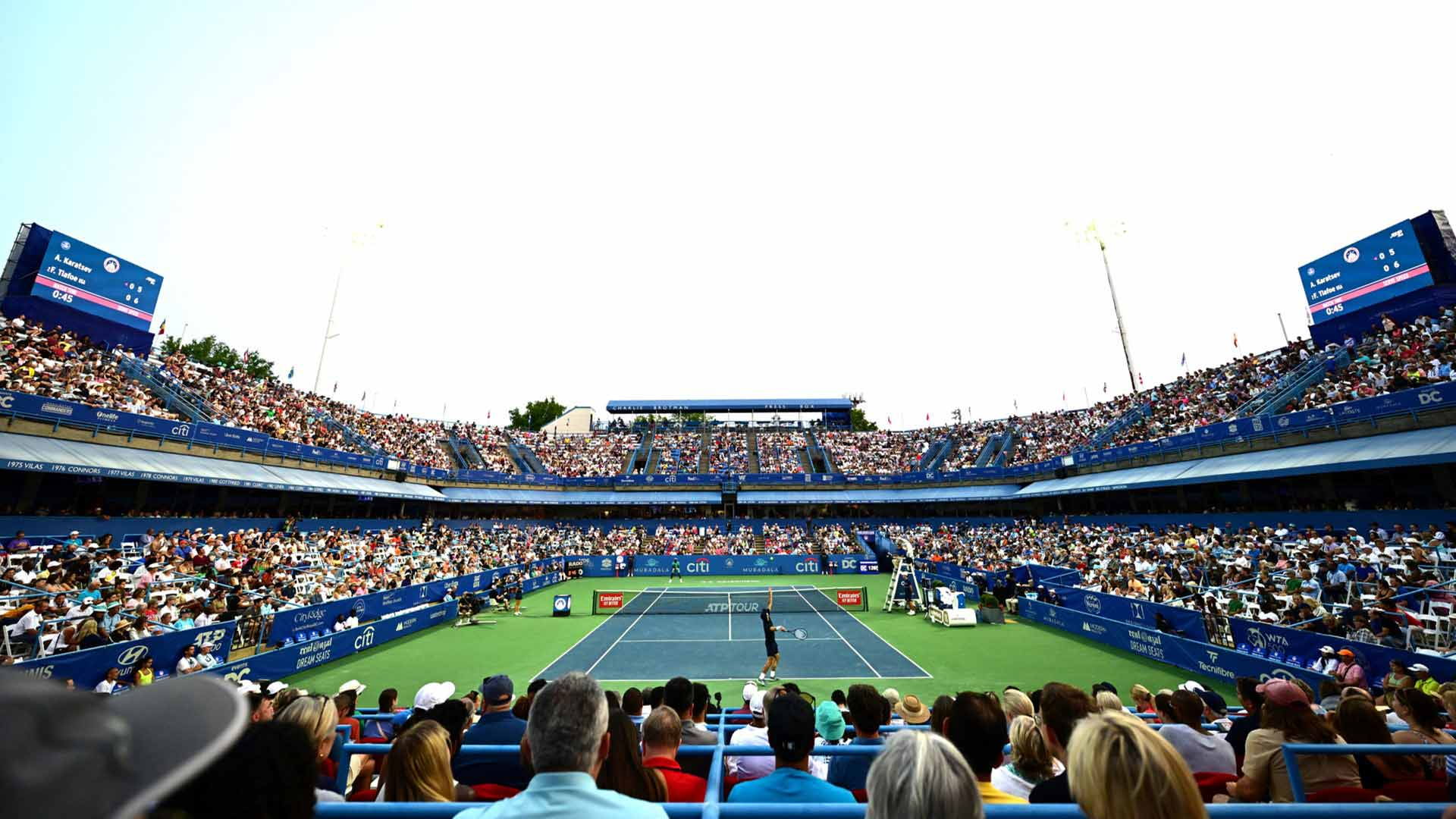
The DC Open is the most distinctive stop on the North American hard-court swing, and most fans underrate it. It is the only combined ATP and WTA 500 in the world, which means you get men's and women's draws of real depth on the same ticket, in a 7,500-seat stadium tucked inside a national park rather than a faceless tennis complex. The scale is the appeal: this is a tournament where the front rows genuinely feel close to the play and the whole grounds can be walked in minutes. The catch is the weather. Late July in Washington is hot and brutally humid, and the tournament knows it, which is why the premium options here lean so hard on air conditioning and shade. Come for the intimacy, the two-tour depth, and a player field that uses DC as a serious US Open tune-up. Plan around the heat and you will have one of the best fan weeks in American tennis.
At a Glance
Dates (2026) | Qualifying July 25 to 26, Main Draw July 27 to August 2 |
Venue | Rock Creek Park Tennis Center, 5220 16th Street NW, Washington, DC 20011 |
Surface | Outdoor hard court |
Level | Combined ATP 500 and WTA 500, the only such combined event in the world |
Main draw singles | ATP 32-player field; WTA 28-player field |
Ranking points | 500 to each singles champion (ATP and WTA) |
First held | 1969 (men's); the longest-running pro event in an equal-access public park |
Capacity | 7,500-seat stadium, 31 courtside suites |
Best for | Fans who want two-tour depth and genuine courtside intimacy on hard courts |
Getting Your Tickets
Tickets run through the tournament's official site and SeatGeek, the ticketing partner, and they break into single-session, full-tournament, and VIP premium options. For a 500-level event the value calculation is unusual, because the combined ATP and WTA format means a single ground-pass day can put a dozen ranked players from both tours in front of you across the outer courts. That depth makes the cheaper sessions better value here than at a comparable single-tour 500.
The structure to understand is the session split. Day sessions and night sessions are ticketed separately on Stadium Court, and the night sessions in the second half of the week are where the marquee singles matches land. If you are buying for atmosphere and star power, a second-week night session is the target. If you are buying for sheer volume of tennis, an early-week day pass gets you qualifying and first-round matches across every court with the run of the grounds.
The premium tier covers Dream Seats on Stadium Court, the Stadium Club, and corporate Hospitality Suites, all sold as full-series rather than single-session. These go through a separate VIP process and the suites in particular tend to clear early to renewing buyers.
Pro tip: The qualifying weekend on July 25 and 26 is the value play almost nobody books deliberately. Qualifying days are cheap or free to enter, the grounds are quiet, and you can stand a few feet from top-100 players grinding for a main-draw spot on the outer courts, with the kind of access that vanishes once the stadium fills mid-week. Tennis sickos treat qualifying weekend as the best-kept secret of the entire swing.
Getting There
Rock Creek Park Tennis Center sits at 5220 16th Street NW, deep inside Rock Creek Park, and the single most important thing to know is that it is not on a Metro line. There is no station you can walk from, and the surrounding streets are residential and aggressively enforced. Do not try to park in the neighborhood: nonresident cars are ticketed and towed, with no exceptions made for tournament traffic.
The cleanest option for most fans is the official shuttle. It runs from two pickup points near the Columbia Heights Metro station on the Green Line, costs $10 round trip through SeatGeek (on sale from mid-July), and starts at 7am with departures every 30 minutes. If you are taking Metro, ride the Green Line to Columbia Heights, exit and cross 14th Street onto Irving Street, and staff will direct you to the shuttle queue at 1400 Irving Street NW. If you are driving to the shuttle, park at the DC USA garage (entrances at 3155 Hiatt Place NW and 1420 Park Road NW), where rates top out around $12 for a full day, then walk to the same Irving Street queue. The shuttle drops at the corner of 16th Street and Morrow Drive, right at the tennis center, with return service ending an hour after the last match.
Rideshare works but is geofenced. Uber and Lyft can only drop and collect on the Carter Barron Amphitheater Box Office Access Road, entrance at 4850 Colorado Avenue NW; they will not pick up or drop on Colorado Avenue itself. From the drop point, staff walk you to the security checkpoint. On-site parking exists but is minimal: a first-come grass field (Lot B) at $50 per vehicle, which the National Park Service can close entirely if it rains. Metro buses D60 and D6X stop at 16th Street and Colorado Avenue if you want the cheapest route in.
Seat Guide
Everything at Rock Creek Park is built around the 7,500-seat Stadium Court, and the small scale is the whole point. Even the upper rows here are closer to the action than mid-tier seats at the bigger hard-court events, so there is no genuinely bad seat in the bowl. The decisions are about sun, angle, and budget rather than salvaging a distant view.
On Stadium Court, the prime real estate is the lower bowl along the sidelines, where you get the classic side-on view of depth and pace. The front rows here are where the Dream Seats sit, directly on the court, and they are the closest paying seats at the tournament. The trade-off is sun exposure: the lower sideline seats sit in open glare for much of the day. The northeast corner is worth knowing about specifically, because that is where the Stadium Club lives, giving an elevated angled view that reads both baselines clearly and climbs above the worst of the afternoon glare.
Sun guidance is not optional planning at this tournament, it is the planning. DC in late July delivers brutal afternoon heat, and the west-facing seats catch the sun hardest through the afternoon sessions. If you are choosing general seating for a day session, aim for the shaded side, which fills first for exactly that reason, or accept that you will need a hat, sunscreen, and water. Night sessions sidestep the problem entirely and are the connoisseur's choice for comfort as much as for the better matches.
The outer courts are where the DC Open earns its reputation among hardcore fans. Because it is a combined event with deep ATP and WTA fields, the grandstand and field courts host genuinely good matches all week, and seating there is general admission and close. Early in the week, posting up on an outer court for a couple of hours gets you within touching distance of ranked players in a way the stadium never allows. For a fan who came to watch tennis rather than to be seen, the outer courts are arguably the best seats at the tournament.
Food and Drink
Catering across Rock Creek Park is handled by Design Cuisine, the award-winning DC caterer that runs everything from the premium suites to the food program, and the quality is a genuine step above standard tournament concessions. In the premium spaces, the Stadium Club and Dream Seats packages put out hors d'oeuvres and snacks all day with an open bar of beer, wine, and sodas, while the corporate suites get bespoke menus built with an account executive. Spirits run on a cash bar across the premium tiers, so budget for that if you drink them.
On the general grounds, the food leans into DC summer-festival fare and rotating local vendors rather than a single anchor concession, with the usual tournament staples backed up by better-than-average options sourced for the event. The grounds carry the official sponsor pours, which in recent years has meant Heineken on the beer side, Kim Crawford wines, and Cîroc and Lobos 1707 on the spirits front, alongside Pepsi products and Justice Tea for the non-drinkers.
The practical advice is about heat as much as taste. DC humidity makes hydration the priority, and the grounds sell water throughout, with electrolyte options from event partners. Eat earlier rather than later to beat the changeover rushes, when the lines spike as everyone moves at once between matches, and carry water from the moment you arrive rather than waiting until you are already overheated.
What to Wear
Dress for heat and humidity first and everything else second. Late July in Washington routinely sits in the 90s Fahrenheit with the kind of swampy humidity the city is famous for, so light, breathable clothing is not a style choice here, it is survival. There is no formal dress code on the grounds: this is an American hard-court event, not Wimbledon, and shorts, summer dresses, polos, and comfortable footwear are the norm even in the premium areas.
The non-negotiables are sun protection. A hat with a brim, sunglasses, and high-SPF sunscreen reapplied through the day will save you, because the stadium's open sideline seats and the outer courts offer little natural shade in the afternoon. Bring a refillable water bottle to fill on site. If you are in a premium suite or the Stadium Club, pack a light layer, because the air conditioning runs cold and the contrast with the outdoor box is sharp.
One DC-specific note: afternoon thunderstorms are common in a Washington summer and can roll in fast. A compact poncho or small umbrella is worth carrying, though check the bag policy first, and be aware that rain can shut the grass parking field entirely.
Bag policy
The DC Open runs a strict clear-bag policy, and the dimensions are specific. Clear plastic, vinyl, or PVC bags are allowed up to 12" x 12" x 6". A small non-clear clutch is permitted but only up to 8" x 5" x 1", which is tight, so do not count on a normal-sized purse getting through. Fanny packs are fine up to 8" x 5". Backpacks are banned outright, clear or not, along with purses, camera cases, binocular cases, hydration packs, and laptops. The camera-case ban catches people out, because the tournament does allow cameras themselves, just not the case to carry one in. Lockers sit out front if you arrive with the wrong bag, but that means a queue and a detour in the heat, so sort your bag before you leave the hotel. One unopened see-through water bottle up to one liter (33.5 oz) is allowed. Only collapsible travel umbrellas make it in, and they cannot be opened inside the stadium or on any match court.
Things to Do Beyond the Tennis
The tournament sits in upper northwest DC, which puts you within easy reach of some of the city's best neighborhoods rather than stranding you at a suburban sports complex. Columbia Heights, where the shuttle connects, is a genuinely good food neighborhood: stop at Call Your Mother on Georgia Avenue for the everything-bagel sandwiches that have a citywide cult following, or head to the original Pho 14 for a bowl that has anchored the area for years.
For something closer to the tennis or a proper dinner after a day session, the 14th Street corridor a little south is one of DC's strongest restaurant strips. Le Diplomate is the see-and-be-seen French brasserie everyone names, and the steak frites and the raw bar live up to it, but book well ahead. For something less precious, Compass Rose on T Street does a globe-trotting menu where the Georgian khachapuri, a boat of bread filled with molten cheese and egg, is the dish people come back for.
If you want to fold in the obvious Washington itinerary, the National Mall and the Smithsonian museums are a short ride south and all free to enter, with the National Gallery of Art and the Air and Space Museum the standouts. Closer to the venue, Rock Creek Park itself is worth the detour for the cool of the tree cover after a hot day on the courts, and the historic Carter Barron area sits right by the rideshare drop. For a drink, the rooftop at the Watergate Hotel, a tournament partner, gives you a Potomac view and a Washington landmark in one stop.
Insider Tip
Book a second-week night session on Stadium Court and treat the afternoon as outer-court time on the same day's separate day ticket if you can stack them. The single highest-value move at the DC Open is using the qualifying weekend (July 25 to 26): entry is cheap, the grounds are calm, and because it is a combined event you can watch both ATP and WTA hopefuls fighting for main-draw spots from a few feet away on the outer courts, with a level of access that is simply gone once the stadium fills by Wednesday. Most casual buyers skip qualifying entirely. They are leaving the best access of the week on the table.
Hospitality Packages
The DC Open's premium options are built around the one thing the venue cannot change, the July heat, which is why every tier leans on air conditioning and shade. Dream Seats put you in the most comfortable chairs directly on Stadium Court with Stadium Club access bundled in, while the Stadium Club itself offers the flexibility to move between a private outdoor box and a cool indoor suite all day. For groups and corporate entertaining, the courtside Hospitality Suites hold up to twenty guests with a private twelve-seat box, a wet bar, private restrooms, and a dedicated planning team. You can view the full list of packages here.
Fan Reviews
Been to the DC Open? Tell us where you sat, what you ate, and what you wish you'd known. Your review helps the next fan choose better, and the best tips make it into this guide. You can contribute a review here.
Ready to book?
Pair this guide with a hospitality package.
Fan Reviews
Sign in to leave a fan review.
No reviews yet. Be the first fan!