The Bybit Stockholm Open Guide for Fans Who Actually Care
Your complete fan guide to the Bybit Stockholm Open at the Kungliga Tennishallen. Tickets, hospitality, where to eat, and what to do in Stockholm
Official guide
A concise editorial reference for guests planning a tournament visit.
The oldest indoor ATP event in the world, played in a building commissioned by a King, in a city that loves to eat and drink
The Quick Verdict
The Stockholm Open has been running since 1969, which makes it the oldest indoor tournament on the ATP Tour. It is played at the Kungliga Tennishallen, the Royal Tennis Hall, a 5,000-seat arena commissioned by King Gustaf V and opened in 1943. The building was not designed for corporate hospitality or broadcast cameras. It was designed for watching tennis, and after more than 80 years it still does that better than almost anywhere else on the circuit.
The champion roll reads like a love letter to the sport: Arthur Ashe, Björn Borg, John McEnroe, Stefan Edberg, Mats Wilander, Thomas Enqvist, Robin Söderling, Stefanos Tsitsipas, Holger Rune, Tommy Paul, Casper Ruud. The tournament draws this calibre year after year because the venue has genuine history, because the late-season calendar slot keeps the competitive stakes high, and because players genuinely enjoy playing here. The arena is steep, compact, and loud. When it fills up on a November evening, the atmosphere wraps around you.
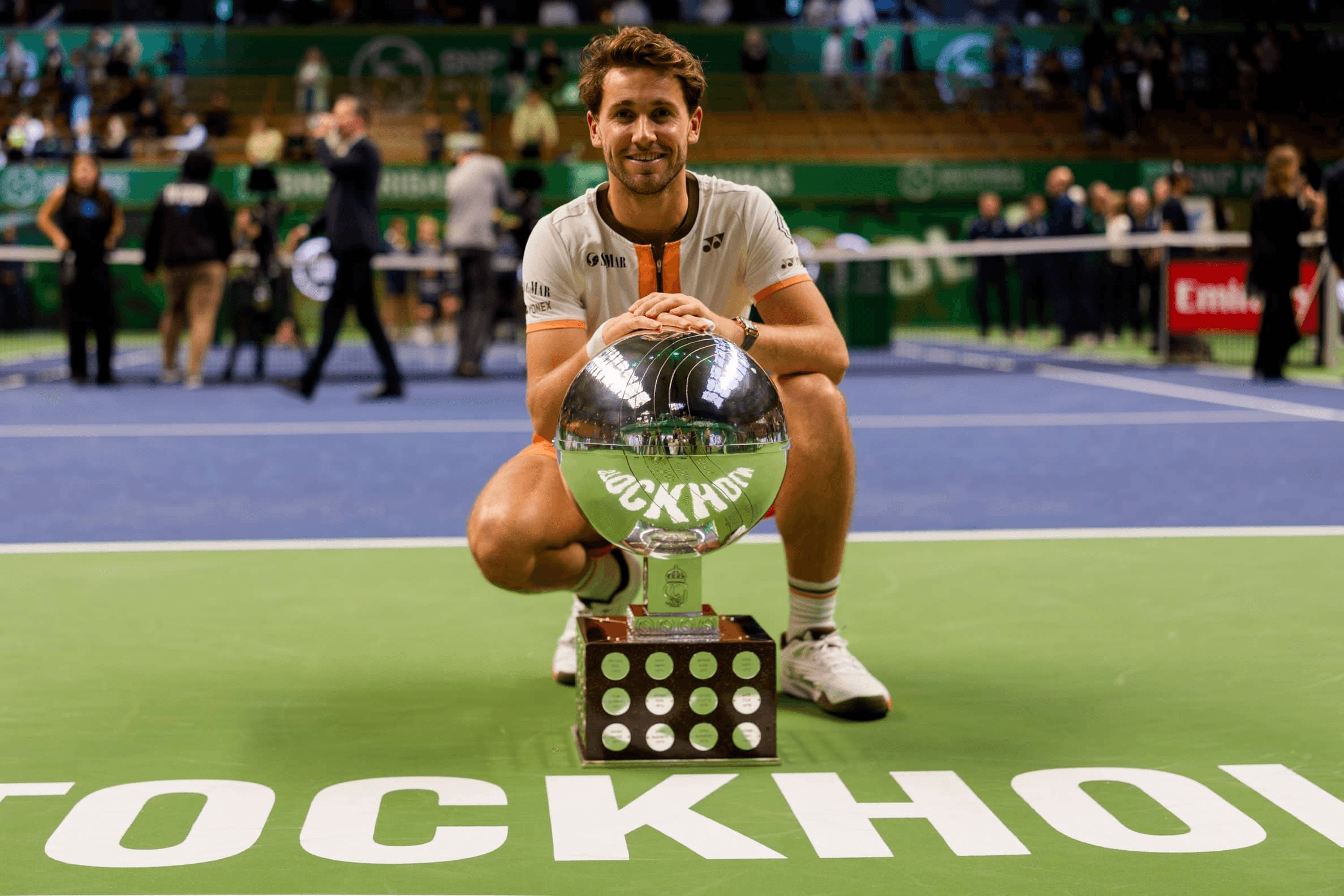
Ruud won the 2025 title and has already confirmed he is coming back to defend. November in Stockholm is dark by 3:30pm, the city turns golden under streetlights, and the Royal Tennis Hall glows from the inside. There is something about watching top-level tennis in a building that a King built for love of the game, in a city that takes food and design and atmosphere as seriously as anywhere on earth. The Stockholm Open is a tournament you attend once and then find yourself planning to come back.
Dates | Saturday 7 November to Saturday 14 November 2026 |
Venue | Kungliga Tennishallen (Royal Tennis Hall), Lidingövägen 75, 115 94 Stockholm |
Surface | Indoor hard court (GreenSet) |
Level | ATP 250 |
Draw | 28 singles / 16 doubles |
Prize money | €723,435 (2026) |
Capacity | 5,000 |
First held | 1969 |
Defending champion | Casper Ruud |
Best for | Fans who want to experience one of the most historically significant venues in tennis, corporate groups looking for a refined November evening in Stockholm, and anyone drawn to the idea of world-class tennis in an arena small enough that every seat feels like the best seat |
Getting Your Tickets
Tickets are sold through the official ticketing site linked from stockholmopen.se. Children under 6 attend free on a ticket holder's lap. Kids aged 6 to 17 have discounted options in the Baselines and Sideline categories during the opening days and the finals day session.
The seating sections at the Kungliga Tennishallen are divided into Baselines (Sections B, C, D, E, H, I, K, and L) and Sidelines (Sections F and G). Sideline seats give you the classic broadcast angle, looking across the net. Baseline seats put you behind the server, where you see the depth and spin of the return game most clearly. Both perspectives are rewarding. At a venue this intimate, you are close to the action from every section.
The Box Experience is the premium general-admission option for fans who want a VIP position without committing to a full hospitality package. Details and pricing are on the official ticketing page.
For full hospitality packages with dining, private lounges, and VIP access, see the Hospitality Packages section below.
Getting There
The Kungliga Tennishallen sits at Lidingövägen 75, on the eastern edge of central Stockholm, in the Östermalm/Gärdet area. This is not a venue on the outskirts of town. It is in the city, surrounded by embassies, parks, and elegant residential streets.
By metro
The nearest station is Gärdet on the red line (T13 or T14). From Gärdet, it is approximately a 10-minute walk east along Lidingövägen to the venue. From T-Centralen (the central hub), the journey to Gärdet takes about 5 minutes. The entire trip from central Stockholm is under 20 minutes.
Karlaplan station, also on the red line, is a slightly longer walk but takes you through the beautiful residential streets of upper Östermalm. Worth it if you have the time and want to see the neighbourhood.
By bus and tram
Several bus routes serve the Lidingövägen corridor. Check SL (Storstockholms Lokaltrafik) for real-time connections from your hotel. Contactless payment works on all SL services.
By taxi or Uber
From central Stockholm, a taxi to the Kungliga Tennishallen takes 10-15 minutes depending on traffic. Uber operates throughout the city. The drop-off is directly outside the venue.
By air
Stockholm Arlanda Airport (ARN) is the main international airport, approximately 40 minutes north of the city. The Arlanda Express train reaches T-Centralen in 20 minutes. Bromma Airport (BMA), closer to the city, handles some domestic and Nordic routes.
By train to Stockholm
Stockholm Central Station handles services from Gothenburg (approximately 3 hours), Malmö (approximately 4.5 hours), and Copenhagen (approximately 5 hours via the Öresund Bridge). From Central Station, take the red metro line two stops to Gärdet.
Seat Guide
The Kungliga Tennishallen was built in 1943 and it carries its history gracefully. The Royal Tennis Hall has been called Stockholm's Madison Square Garden, and while the scale is different, the comparison captures something true about the building's presence. The arena is compact, steeply raked, and designed to bring the crowd as close to the court as possible. When it fills on a November evening, the sound concentrates under the low roof in a way that larger, modern arenas rarely achieve.
Seating is divided into Baselines (Sections B, C, D, E, H, I, K, and L) and Sidelines (Sections F and G). Sideline seats offer the traditional viewing angle along the length of the court, where you see the net, the angles, and the geometry of rallies. Baseline seats sit behind the server and reveal the depth of the game: how deep a return lands, how much spin is on a second serve, how far behind the baseline a player positions for the return. Both are worth experiencing across different sessions if you attend multiple days.
For hospitality guests, Winners Table by Teatergrillen includes the best seats in the house. The Private Skyview Box and Executive Box offer elevated positions with views down onto the court from private lounges. The Swedish Royal Trophy Lounge sits metres from the Centre Court stands, making the walk between your lounge and your seat almost effortless.
No sun guidance needed. This is indoor tennis under consistent lighting. November in Stockholm. Bring your appetite, not your sunscreen.
Food and Drink
Inside the arena
Svenska Brasserier handle all catering in the Kungliga Tennishallen, and the name carries weight. This is the restaurant group behind Riche, Sturehof, Teatergrillen, Ulriksdals Värdshus, and Gondolen, five of Stockholm's most respected dining rooms. They approach the tournament as a proper kitchen operation.
For general admission visitors, a food market offers a range of options throughout sessions. Next to Competition Court 1, the Fazer Café serves coffee, pastries, beer, and wine. Outside the arena, pizza is available for anyone who wants something hot and immediate.
For hospitality guests, the food is a genuine highlight. Winners Table by Teatergrillen serves a three-course lunch or dinner. The Executive Box provides access to the VIP Village where Teatergrillen runs a full three-course restaurant service. The Swedish Royal Trophy Lounge offers walking buffets that range from cocktail party style to full dinner spreads. The quality across all of them reflects the calibre of the restaurants behind them.
Stockholm: the food
Stockholm has spent the last two decades building one of Europe's most exciting food cultures. The combination of Scandinavian ingredient obsession, a strong fine-dining tradition, and a casual scene that cares deeply about quality without taking itself too seriously makes eating out here a pleasure at every price point.
Start with what you came for: Swedish meatballs. Köttbullar with lingonberry jam, pickled cucumber, cream sauce, and mashed potato is the national dish, and the difference between a good version and a great version is worth seeking out. Meatballs for the People in Södermalm is the dedicated destination, with a sampler plate that lets you try several varieties including game and plant-based options. Pelikan, also in Södermalm, is a grand beer hall with vaulted ceilings and a version of the dish that has been on the menu for over a century. Operabaren at the Royal Opera House serves the classic in a room with hand-carved wood panels and stained glass ceilings that has looked the same for generations. Tranan in Vasastan reportedly serves Will Ferrell's favourite meatballs in Stockholm, a recommendation that is hard to argue with.
Riche and Sturehof, both Svenska Brasserier restaurants and both within walking distance of the Kungliga Tennishallen in Östermalm, are natural choices for dinner after an evening session. Sturehof does outstanding seafood. The toast Skagen (prawns, crème fraîche, dill, and bleak roe on toast) is a Stockholm staple and theirs is one of the finest.
For a special dinner during tournament week: Ekstedt in Östermalm cooks everything over an open wood fire and holds a Michelin star. The kitchen is visible from the dining room and the experience of watching food cooked over birchwood is sensory in a way that stays with you. Operakällaren is the grand occasion restaurant, housed in the Royal Opera House, with refined Swedish cuisine served in a room that glitters with gilded elegance. Mathias Dahlgren Matbaren at the Grand Hôtel is a New Nordic bistro from one of Sweden's most celebrated chefs. The herring with rye bread and potatoes is a fixture on the menu and a lesson in how simple ingredients, handled with care, can be extraordinary.
Lisa Elmqvist inside the Östermalms Saluhall is a fourth-generation family seafood restaurant. The gravad lax and toast Skagen are essential. The market hall itself, rebuilt and reopened in 2020, is one of the most beautiful food halls in Scandinavia and a 15-minute walk from the venue.
Swedish fika, the daily ritual of coffee and something sweet, is not a marketing concept. It is a genuine practice, taken seriously and observed often. Vete-Katten on Kungsgatan has been the quintessential Stockholm café since 1928, with pastries, cakes, and cinnamon buns (kanelbullar) in an interior that feels unchanged. Take fika here on a cold November afternoon before an evening session. The warmth of the room, the smell of cardamom, and the first sip of coffee after the cold outside is a small, perfect pleasure.
What to Wear
No formal dress code for general admission. The Stockholm crowd dresses with the effortless good taste that Scandinavians are known for: understated, well-fitted, and comfortable. Dark jeans, a good knit, clean shoes. For the hospitality packages, especially Winners Table by Teatergrillen and the Executive Box, smart dress is appropriate. You are eating a three-course dinner by one of Stockholm's best restaurant groups. Dress like you would for the restaurant itself.
November in Stockholm is cold. Temperatures hover between 1 and 6 degrees Celsius during the day and drop below zero at night. It gets dark by 3:30pm. Rain, sleet, or early snow are all possible. A proper winter coat, scarf, gloves, and waterproof shoes are essential for the walk from Gärdet station to the venue. The arena is heated, but the 10-minute walk through November Stockholm calls for layers.
Oscar Jacobson, the Swedish fashion brand, is a premium partner of the tournament. If the trip inspires a wardrobe addition, Östermalm is the neighbourhood for it.
Things to Do Beyond the Tennis
The venue itself
Take a moment to appreciate the Kungliga Tennishallen before you go inside. This building was commissioned by King Gustaf V during the Second World War because his love for tennis was deep enough to build an arena for it while the world was in turmoil. Crown Prince Gustaf had discovered tennis in England in 1879 and brought it home to Sweden. By 1943, his dedication to the sport had produced this. The Royal Tennis Hall has been in continuous use ever since. Led Zeppelin played here in 1973. Ingemar Johansson boxed here in 1962. Borg practised here as a teenager. The building holds all of that history, and you feel it when you walk through the doors.
Gamla Stan
Stockholm's medieval old town is a tangle of narrow cobblestone streets, ochre and amber buildings, and the Royal Palace. The Nobel Prize Museum sits on the main square. The Storkyrkan (Great Church) rises above the rooftops. In November, the summer crowds are gone, the Christmas lights begin to appear, and the neighbourhood feels quieter and more atmospheric than at any other time of year. A 20-minute metro ride from Gärdet.
The Vasa Museum
In 1628, the warship Vasa sank in Stockholm harbour on its maiden voyage. In 1961, it was raised from the seabed, 95% intact. It now sits in its own purpose-built museum on Djurgården, and it is one of the most extraordinary things you will ever see indoors. The ship is 69 metres long and covered in hundreds of carved wooden sculptures. The museum is approximately 20 minutes on foot from the Kungliga Tennishallen.
Fotografiska
Stockholm's photography museum, housed in a former customs building on the Södermalm waterfront. The exhibitions rotate and consistently surprise. The top-floor restaurant has one of the best views in Stockholm and a menu that would justify a visit on its own. Open late, which makes it a natural stop after a day session.
The Östermalms Saluhall
Stockholm's premier food hall, beautifully rebuilt and reopened in 2020. Come for lunch at Lisa Elmqvist, wander the fish counters and cheese stalls, and absorb the atmosphere of a market hall that feels like it was designed for lingering. A 15-minute walk from the venue.
Djurgården
The island park that contains the Vasa Museum, Skansen (the world's oldest open-air museum, founded in 1891), the ABBA Museum, and Rosendals Trädgård, a greenhouse café and garden serving biodynamic food in one of the most peaceful settings in Stockholm. In November, the island is quiet. The trees are bare, the paths are empty, and the light has that soft grey-gold quality that draws photographers to Scandinavia.
The Stockholm archipelago
If you have a free day during the tournament, consider a winter boat trip through Stockholm's archipelago. Strömma and Waxholmsbolaget operate year-round ferries to the inner islands. The boats are heated. The views of pine-covered islands emerging from November mist, with the city slowly disappearing behind you, are the kind of thing you remember long after you have forgotten who won the second round.
Insider Tip
The Stockholm Open started in 1969 with a story that could only belong to this tournament. The organisers forgot to tell some of the biggest names in the draw when the event actually began. The inaugural champion, Nikola Pilić, celebrated by buying drinks for every other player in the draw, and reportedly left Sweden with considerably less prize money than he had anticipated. The tournament has been running ever since, and something of that first edition, warm, slightly chaotic, and genuinely in love with the sport, lives on in the event today.
If you can attend one session, make it a weekday evening. The Kungliga Tennishallen on a cold November night, with the arena full and a top-20 player serving to save the set under the lights, is as good as indoor tennis gets. Walk to Sturehof afterwards for toast Skagen and a glass of wine, a 15-minute stroll through Östermalm, and you will have had one of the finest sporting evenings available anywhere in Europe in November.
Hospitality Packages
The Bybit Stockholm Open offers four hospitality packages, all catered by the restaurant group behind Riche, Sturehof, Teatergrillen, Ulriksdals Värdshus, and Gondolen.
Winners Table by Teatergrillen is the most intimate option. A three-course lunch or dinner by Teatergrillen paired with the best seats in the arena, at a reserved table for 2 to 10 guests. The format works beautifully for anything from a dinner for two to a team celebration for ten. Pricing on request.
Private Skyview Box is your own VIP lounge above Centre Court with an exclusive meal for 8 to 12 guests. Dinner and the match happen in the same room. The food comes to you. The tennis unfolds below you. Pricing on request.
Swedish Royal Trophy Lounge is the dedicated corporate hosting option. Named after the perpetual trophy donated by King Carl XVI Gustaf, and located metres from Centre Court. Walking buffet, bar, and premium Centre Court tickets for 30 to 60 guests. Lounge hire from SEK 30,000 per session. Tickets, catering, and drinks priced separately.
Executive Box is the pinnacle of the programme. Three-time champion Thomas Enqvist presents the day's matches to your group before the main event on Centre Court. A private front-row lounge for up to 25 guests with VIP Village access and three-course dining by Teatergrillen. From SEK 150,000 per session excluding catering and VAT.
Enquire through experience.tennis for availability, session recommendations, and booking.
Fan Reviews
Been to the Bybit Stockholm Open at the Kungliga Tennishallen? Tell us where you sat, what you ate in the city, which sessions you attended, and what surprised you most. Your review helps the next fan plan their trip, and the best tips make it into this guide.
Submit your Stockholm Open review →
Last updated: July 2026. Know something we don't? Submit a tip and we'll add it to the guide.
Ready to book?
Pair this guide with a hospitality package.
Fan Reviews
Sign in to leave a fan review.
No reviews yet. Be the first fan!