The Kinoshita Group Japan Open Guide for Fans Who Actually Care
Asia's longest-running ATP tournament and one of the most genuinely rewarding stops on the entire tour for fans who make the trip
Official guide
A concise editorial reference for guests planning a tournament visit.
Everything you need to know before you go — written by fans, not PR departments
The Quick Verdict
The Japan Open is Asia's longest-running ATP tournament and one of the most genuinely rewarding stops on the entire tour for fans who make the trip. Tokyo in early October is spectacular — the summer heat has broken, the city is at its most liveable, and the Ariake Tennis Park delivers world-class tennis in an atmosphere that is unlike anything you will experience at a European or American event. Japanese tennis crowds are knowledgeable, respectful, and intensely passionate in a way that is specific to this country and this sport. The 2026 edition carries an additional layer of significance that makes attendance not just appealing but important: Kei Nishikori will make his final Japan Open appearance at a tournament where he won back-to-back titles in 2012 and 2014. For any serious tennis fan, this is a farewell worth being present for.
Dates | 30 September — 6 October 2026 |
Venue | Ariake Colosseum, Ariake Tennis Forest Park, 2-2-22 Ariake, Koto-ku, Tokyo 135-0063 |
Surface | Outdoor hard court |
Level | ATP 500 |
Draw size | 32 singles, 16 doubles |
Ranking points | 500 (singles champion) |
First held | 1972 (Asia's longest-running ATP tournament) |
Best for | Tennis fans combining a Tokyo trip with world-class tennis, fans who want to witness Kei Nishikori's farewell, and anyone who has not yet experienced Japanese tournament atmosphere |
Getting Your Tickets — Read This Before You Do Anything Else
Buying tickets for the Japan Open as an international visitor is the single most logistically complex aspect of attending this tournament. It deserves more attention than any other section in this guide.
The Core Problem
Japanese events have a reputation for being quite tricky for foreigners to purchase due to a common requirement of a local mobile number. The primary ticketing platforms — Ticket Pia, e+, and Lawson Ticket — all require a Japanese domestic phone number for account registration. This is not a minor inconvenience. It is a genuine barrier that blocks most international fans from purchasing directly.
The Official Route
Tickets for the Japan Open typically go on sale during July and August, so keep an eye on the official tournament website during that period for information on how to secure a seat. The official site at japanopentennis.com publishes ticket information in both Japanese and English. For 2026, check the site from July onwards.
International fans have several workable options. Some platforms including Ticket Pia accept international Visa and Mastercard without requiring a Japanese phone number for specific events — this varies by tournament and is worth checking directly. TicketX allows you to search, purchase, and receive tickets 100% online, even while abroad, unlike Japanese ticketing platforms that require in-person payment or a Japanese phone number. This makes it one of the most reliable options for overseas visitors.
ATP Experiences is the official ATP hospitality and ticket partner and handles international bookings directly without the Japanese platform complications. For hospitality packages with tickets included, this is the cleanest route for international fans. See the hospitality section below.
The Nishikori Factor
The 2026 main draw takes place from 30 September through 6 October, and Nishikori's confirmed final appearance means demand for tickets will be significantly higher than a typical year. His wildcard entry will almost certainly be for the main draw rather than qualifying, meaning his matches will be on Ariake Colosseum. Book as early as possible once sales open. Do not assume you can purchase at the gate or find tickets in the week before the event.
Pro tip: If you cannot get tickets through the official route, authorised international resellers including Championship Tennis Tours have historically offered Japan Open packages that bundle tickets with Tokyo hotel accommodation. These packages remove the ticketing complexity entirely and are worth exploring if the direct purchase route proves difficult.
Getting There — The Yurikamome Line is Your Answer
Ariake Tennis Park is located 650 metres from Ariake station, an eight-minute walk, on the Yurikamome Line. This is your primary route. Sky Sports
The Yurikamome is an automated, driverless monorail that runs from Shimbashi station in central Tokyo out to the waterfront Odaiba and Ariake district. From Shimbashi it takes approximately 20 minutes to reach Ariake-Tennis-no-Mori station, which is the station directly named for the venue and places you as close to the gates as any public transit stop gets. Shimbashi connects to the JR Yamanote Line, meaning you can reach it from Shinjuku, Shibuya, Tokyo Station, and virtually anywhere on the central loop in under 30 minutes.
The venue is also a 1.7 kilometre walk from Tokyo Teleport station on the Rinkai Line. The Rinkai Line connects to Osaki on the Yamanote Line, giving you a second route from the south and west of the city. Sky Sports
There is no public parking at the venue during events. This is not a suggestion — there is genuinely nowhere to park. Do not drive. The Ariake waterfront area has limited street parking and roads are congested on match days. The monorail removes this problem entirely. Sky Sports
For visitors staying in central Tokyo: Shinjuku to Ariake-Tennis-no-Mori runs about 40 minutes. Shibuya is similar. Ginza, which sits between Shimbashi and the venue on the Yurikamome route, puts you about 25 minutes away. The Ariake area is in the eastern waterfront district, which feels very different from central Tokyo — more modern, more open, and surprisingly navigable on foot once you arrive.
Arriving with time: Build in extra time on busy days. The Yurikamome is a single-line monorail and on peak sessions it fills up with tennis fans. The 20-minute journey from Shimbashi can become a 40-minute experience including queuing for the monorail on a busy Friday or Saturday. Arriving 60 to 90 minutes before your session starts is the right approach.
Seat Guide — Ariake Colosseum and Beyond
Ariake Colosseum
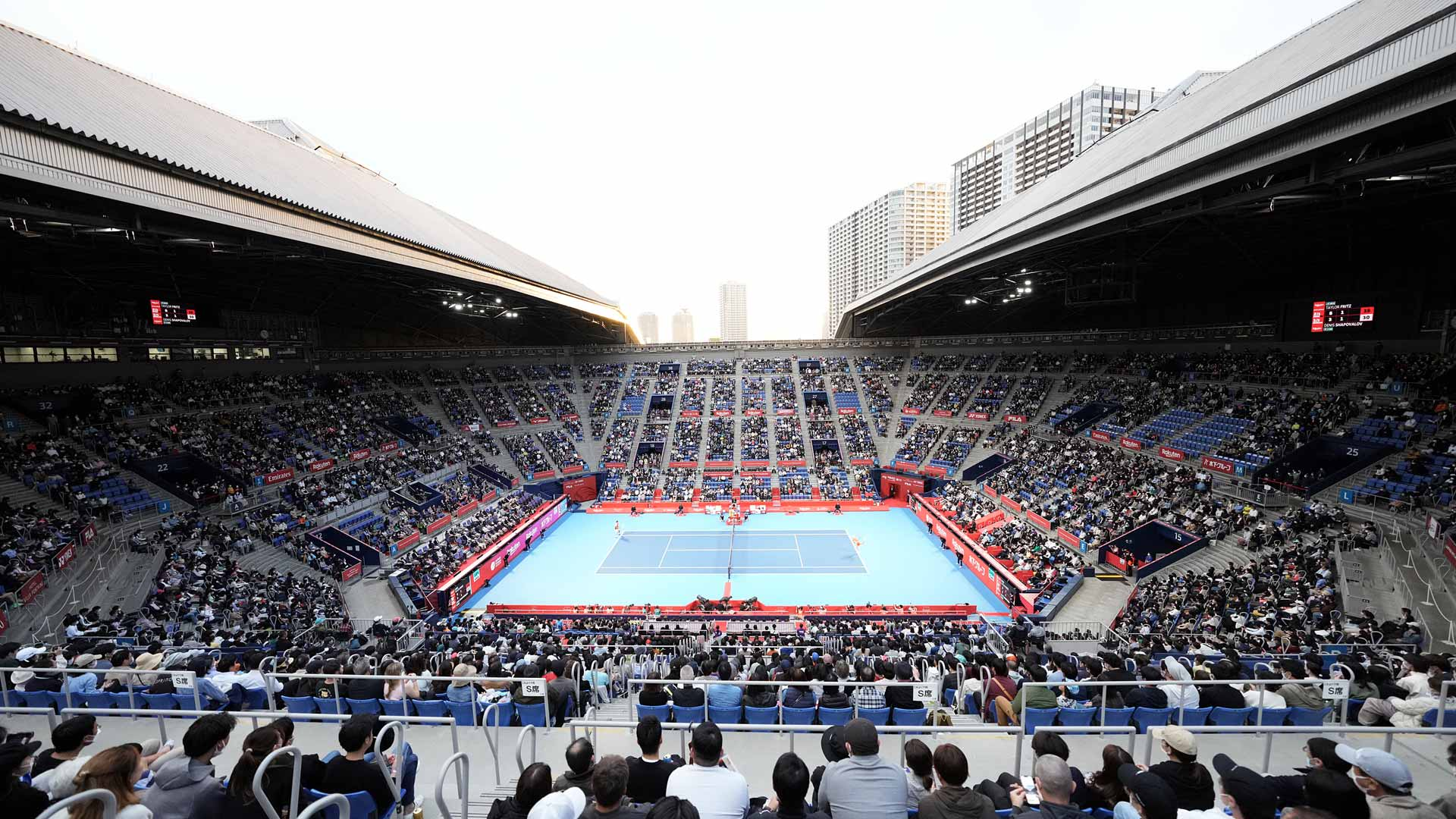
The Ariake Colosseum is one of the first tennis venues in the world to have been equipped with a retractable roof. This is practically significant — October in Tokyo is generally dry and mild, but when rain does arrive it can be heavy, and the roof means play on the main court continues uninterrupted regardless of conditions.
The Colosseum capacity is approximately 10,000 for tennis. The lower bowl feels intimate and close to the court across all sections — there are genuinely few bad seats in this stadium. The upper tier delivers the full-court tactical perspective that rewards fans who want to read rallies and positioning rather than just the individual shot.
The venue is well-equipped with VIP areas for those seeking a more exclusive experience, with excellent seating arrangements, high-definition video screens, and full accessibility.
Sun guidance: The roof is retractable rather than fixed shade, so direct sun exposure depends on whether the roof is open or closed. When open, afternoon sessions put the west side of the stadium in more direct sun. For day sessions, the east side of the upper tier tends to be more comfortable in the afternoon. Evening sessions run from approximately 6pm and are typically the most atmospheric — the stadium lighting, the cooler temperatures, and the compressed crowd energy make night sessions at Ariake genuinely special.
Ariake Tennis Forest Park Outer Courts
The Ariake Tennis Park is an expansive tennis centre comprising 48 courts. The outer courts host first-round matches and doubles throughout the week and are accessible to ground pass holders. Early in the week, top-seeded players may appear on the outer courts in first-round matches depending on the draw and scheduling. The outer court experience at Ariake is excellent — the park setting, the proximity to players, and the relaxed atmosphere make it a worthwhile part of any first day.
Food and Drink — Japan Gets This Right
Japanese sports venues have a better food culture than almost any equivalent venue in Europe or North America. This is not hyperbole — it reflects genuine care about the quality of what is served, and the Japan Open is no exception.
Expect a range of vendors offering yakitori, bento boxes, ramen, and sushi alongside more standard tournament fare. The quality baseline is high. Prices are reasonable by tournament standards — significantly lower than Wimbledon or the US Open for equivalent food quality.
Cash is important. Japan remains more cash-dependent than most Western countries, particularly at food vendors and smaller concession stands. Some vendors accept IC cards (Suica, Pasmo), which international visitors can load at any JR station machine. Bring both cash and your IC card. Do not rely solely on international credit cards at the venue.
Outside food policy: Standard Japanese venue policy prohibits outside food and drink beyond sealed water bottles. Confirm the specific policy for 2026 on the official tournament website before attending.
After the tennis — Ariake and Odaiba: The waterfront Odaiba entertainment district is a five-minute walk from the venue and has extensive dining options in DiverCity Tokyo Plaza and the Aqua City shopping complex. For something more local and less tourist-oriented, the Koto-ku neighbourhood around the venue has excellent ramen and izakaya options that serve later into the evening.
In central Tokyo: Tokyo's food scene is the best in the world by a number of measures. The city has more Michelin-starred restaurants than Paris. For a post-match dinner worth planning around: Tsukiji Outer Market is accessible from the Yurikamome at Shiodome and is spectacular at lunch time. Shinjuku's Omoide Yokocho (Memory Lane) is an unmissable evening experience — a narrow alley of tiny yakitori stalls running since the 1940s. Ginza has some of Tokyo's finest formal dining. Shibuya and Harajuku are the right neighbourhoods for something more casual and contemporary.
What to Wear
No formal dress code applies to general spectators. The Japan Open crowd is smart-casual — clean, considered, and noticeably more put-together than an American tournament crowd but less formal than Wimbledon. Treat it like a smart day out in a major city rather than a sporting event where anything goes.
October in Tokyo is autumn and one of the best months in the Japanese calendar weather-wise. Temperatures typically sit between 18 and 24 degrees Celsius during the day, dropping to 14 to 17 degrees in the evening. Light layers are the right approach — a shirt or blouse with a light jacket is comfortable for both day and evening sessions. The humidity that makes Tokyo summers punishing has largely dissipated by October.
Comfortable walking shoes matter. The Ariake Tennis Park is spacious and a full day on the grounds involves significant walking between courts, food areas, and the main stadium. The walk from Ariake-Tennis-no-Mori station to the gates is pleasant but worth factoring into your footwear choice.
One practical note unique to Japan: the culture of standing in queues extends to entering stadiums and accessing concessions. Expect orderly, patient queuing and follow the same approach. Attempting to jump queues or cut through is noticed and causes genuine social friction in a way that might not be the case in other countries.
Things to Do Beyond the Tennis
On the Grounds
The Ariake Tennis Forest Park is a genuine park — greenery, open space, and a pleasant environment to spend time between sessions. The park setting makes wandering between outer courts, grabbing food, and sitting in the sun between matches a considerably more enjoyable experience than the more urban venue environments of Montreal or Cincinnati.
The tournament typically features a player autograph zone at some point during the week — check the daily schedule once published. Given Nishikori's farewell 2026 appearance, any official signing or fan engagement session involving him will be heavily attended. Arrive early.
The Nishikori Farewell
This deserves its own mention. Kei Nishikori announced his retirement at the end of the 2026 season. At a tournament where he won back-to-back titles in 2012 and 2014, and where he is worshipped as the greatest Japanese player in the history of the sport, his final Japan Open appearance will be one of the more emotionally significant tennis moments of the year. The crowd response to his matches will be unlike anything you have experienced at a tennis tournament. If you are going to be in Tokyo in early October 2026, his matches are the sessions to prioritise.
Tokyo as a Destination
Tokyo is one of the world's great cities and October is one of its best months. A short list of things that reward the effort of being there:
Senso-ji temple in Asakusa — Tokyo's oldest temple, most atmospheric at dawn before the crowds arrive. Meiji Shrine in Harajuku — a forested Shinto shrine in the middle of the city, genuinely peaceful. The teamLab Planets digital art installation in Toyosu is a 15-minute walk from Ariake and worth an evening. Tsukiji Outer Market for breakfast on a match morning. The Tokyo National Museum in Ueno for Japanese art and cultural history. Shibuya Crossing at night — not a tourist cliché, genuinely one of the most extraordinary urban spaces in the world.
If you are extending beyond Tokyo: Kyoto is two and a half hours by Shinkansen and incomparable in autumn, when the maple leaves begin to turn. Hakone, about 90 minutes from Shinjuku, has views of Mount Fuji on clear days and excellent hot spring (onsen) accommodation that rewards a single night's stay.
The Practical Japan Tips No Other Guide Will Tell You
These are things that matter specifically for international visitors and are worth knowing before you land.
Get a Suica or Pasmo IC card at the airport on arrival. Load it with ¥5,000 to start. Use it for every train journey, convenience store purchase, and some venue concessions. It removes the need for cash handling on every transaction and works across all rail, metro, and bus networks in Tokyo.
Download Google Maps offline for Tokyo before you travel. The mapping in Tokyo is excellent but mobile data can be patchy in tunnels and some indoor areas. Having offline maps removes the anxiety of navigating in a city where street signs are primarily in Japanese.
Google Translate with camera mode is the most practically useful tool in Japan for an international visitor. Point your phone camera at a menu, a sign, or a ticket and get an instant translation. More useful than any phrasebook.
Convenience stores in Japan — 7-Eleven, FamilyMart, Lawson — are genuinely good. Onigiri, hot food, excellent coffee, and all the practical supplies you might forget. There will be at least two within five minutes of your hotel wherever in Tokyo you are staying.
Tipping is not practised in Japan and attempting to tip can cause embarrassment. Excellent service is the standard, not a behaviour that requires financial acknowledgment.
Hospitality Packages
The Japan Open's official hospitality partner for international visitors is ATP Experiences, which offers premium packages including reserved seating and exclusive access elements. Given the ticketing complexity for international fans, a hospitality package that bundles confirmed tickets with the hospitality experience is a particularly sensible option for the Japan Open compared to other tournaments where general tickets are more easily accessible. We have curated the available hospitality options — view Japan Open hospitality packages here.
Fan Reviews
This section grows with every tournament. Be the first to share your Japan Open experience — submit a review after attending and help the next fan plan their trip.
Submit your Japan Open review →
Ready to book?
Pair this guide with a hospitality package.
Fan Reviews
Sign in to leave a fan review.
No reviews yet. Be the first fan!