The Erste Bank Open Vienna Guide for Fans Who Actually Care
World-class indoor tennis in one of Europe's iconic cities, for anyone who wants to combine serious tennis with serious food, music, and culture
Official guide
A concise editorial reference for guests planning a tournament visit.
Everything you need to know before you go — written by fans, not PR departments
The Quick Verdict
Vienna in late October is one of the great European autumn experiences, and the Erste Bank Open is one of the great reasons to be there. The tournament has been held at the Wiener Stadthalle since 1974, and the list of winners reads like a who's who of the sport — Agassi, Becker, Federer, Djokovic, Thiem, Medvedev, Zverev, Sinner. This is not a mid-tier event that happens to be in a beautiful city. It is a proper ATP 500 that consistently draws world-class fields, with a fast indoor surface that rewards aggressive tennis and produces the kind of flat, compressed rallies that make indoor hard-court play genuinely exciting to watch in a stadium.
The 2026 edition adds a specific wrinkle: Alexander Zverev and Flavio Cobolli, the Paris finalists, are both confirmed for Vienna, and the Erste Bank Open Tie-break tournament on 23 October featuring six stars of the draw including Jakub Menšík gives fans an additional evening of elite tennis before the main draw even begins. Add a pre-match cocktail at one of the city's legendary coffeehouses, a Wiener Schnitzel, and a walk past the Kunsthistorisches Museum on the way home, and Vienna gives the Erste Bank Open a context that most tournaments simply cannot match.
Dates | Friday 23 October (Tie-break event) — Sunday 1 November 2026 |
Main draw | Saturday 24 October — Sunday 1 November 2026 |
Venue | Wiener Stadthalle Hall D, Roland Rainer Platz 1, 1150 Vienna, Austria |
Second venue | Marx Halle, Karl Farkas Gasse 19, 1030 Vienna |
Surface | Indoor hard court |
Level | ATP 500 |
Draw size | 28 singles, 16 doubles |
Ranking points | 500 (singles champion) |
Prize money | €2,584,000 |
First held | 1974 (53rd edition in 2026) |
Defending champion | Jannik Sinner |
Best for | Tennis fans who want world-class indoor tennis in one of Europe's great cultural cities, corporate groups for whom the VIP Club is an annual client entertainment fixture, and anyone who wants to combine serious tennis with serious food, music, and coffeehouse culture |
Getting Your Tickets — Read This First
Tickets for the Erste Bank Open are sold through the official tournament website at erstebank-open.com, through Wien-Ticket, and directly at the Wiener Stadthalle box office. A ticket for the Erste Bank Open at the Wiener Stadthalle is valid for the entire day - you can watch all matches on Centre Court that are played on that day. This is a genuinely useful format. You are not buying a session ticket for a single match. You are buying access to the full day's play, which in the early rounds means multiple matches across the day before evening sessions bring the headline names.
Tickets can also be purchased through Wien-Ticket or directly at the Wiener Stadthalle. Prices adjust dynamically throughout the sales period — earlier purchases are generally cheaper, and prices rise as specific match days gain confirmed big-name participants. Check the online shop for daily-updated pricing rather than expecting a fixed price list.
The Tie-break Tournament — October 23
The evening of 23 October, the day before main draw play begins, hosts the Erste Bank Open Tie-break tournament — an innovative tie-break tournament with six stars of the Erste Bank Open like Jakub Menšík. This is a separate ticketed event and a genuinely good evening of tennis in a format that rewards aggressive shotmaking from the first point. If you are arriving in Vienna on the 23rd, this is worth building into your first evening.
Early access and discounts
ÖTV licensed players receive a 10% discount on ÖTV Day (Wednesday of the tournament week) and a 5% discount on all other match days. Register at the official site for early access notification before public sales.
The "Same Time, Same Station" programme — secure your tickets for the 2026 Erste Bank Open during the 2025 tournament, on the same day of the week, in the same seat, and with up to 20% off. If you attended in 2025, this is the most cost-effective way to lock in 2026 seats.
Children
Children up to age five can sit on a lap for €6, purchased at the Stadthalle box office on the day. Children aged six and over require their own ticket.
Wheelchair access
Wheelchair tickets are solely available at the ticket counters of Wiener Stadthalle, by calling +43 1 98 100-480 or -200, or via the accessibility email.
Getting There - The U6 is the Right Answer
The Wiener Stadthalle is Austria's largest multi-purpose arena, with a central location in Vienna's 15th district and easy accessibility by public transport.
By metro:
Take the U6 line to Burggasse-Stadthalle station - approximately a 5-minute walk to the venue. The U6 runs from Siebenhirten in the south through the city and connects at Westbahnhof to the U3, and at Längenfeldgasse to the U4. From the city centre (Stephansplatz), the most direct route is U3 west to Westbahnhof, then change to U6 one stop to Burggasse-Stadthalle. Total journey from the first district is approximately 15 to 20 minutes.
By tram:
Tram line 48A stops at Moeringgasse. Trams 5, 6, 9, 18, 49, and 52 all serve the broader Westbahnhof and Stadthalle area, making the venue accessible from multiple directions without needing the metro.
Your ticket is a transport pass:
This is one of the most practical fan benefits in Austrian tennis. The admission ticket is valid as a public transport pass on the day of the booked event from 00:00 to 24:00 on all Wiener Linien services and on all VOR routes within Vienna's core zone. Arrive by metro, leave by tram, and pay nothing extra for any Viennese public transport across the entire day.
The Marx Halle - Vienna's second tournament venue
Marx Halle is the new second match location for the Erste Bank Open in Vienna's third district. Vibrant, diverse, and right in the heart of it all. The Ground Ticket for tennis at Marx Halle allows you to take full advantage of this new location - top-class tennis, side events, entertainment, and up close and personal with the stars' training sessions, for just €25 for the whole day.
Marx Halle is located at Karl Farkas Gasse 19, 1030 Vienna. By metro: U3 to Schlachthausgasse. By S-Bahn: 5 minutes from St. Marx station. By tram: Line 71 to St. Marx station, or Line 18 to Viehmarktgasse or St. Marx station. The Marx Halle ticket also serves as a public transport pass for the day.
The Marx Halle is not a secondary event. It is a separate, atmospheric venue with its own programme — players train here, side events run alongside the tennis, and the open, energetic setting is meaningfully different from the Stadthalle bowl. For fans who want to move between the two venues across a full day — watching early rounds at Marx Halle in the afternoon and heading to the Stadthalle for evening play — Vienna's transport connections make this easy.
By air:
Vienna International Airport (VIE) is served by direct flights from most major European cities and several long-haul destinations. The City Airport Train (CAT) runs non-stop to Wien Mitte station in 16 minutes, from where you can connect to the U3 westbound toward the Stadthalle. The S7 S-Bahn is cheaper and slightly slower (about 25 minutes to Mitte) but covers the same route. Both run frequently.
By rail:
Vienna is exceptionally well-connected by rail. From Zurich: approximately 8 hours direct. From Munich: approximately 4 hours. From Budapest: approximately 2 hours 40 minutes. From Prague: approximately 4 hours. Westbahnhof is the arrival station for trains from Germany and Switzerland, and is one U6 stop from the Stadthalle - arguably the most convenient airport-to-venue transfer of any tournament in Central Europe.
Seat Guide - Wiener Stadthalle Hall D
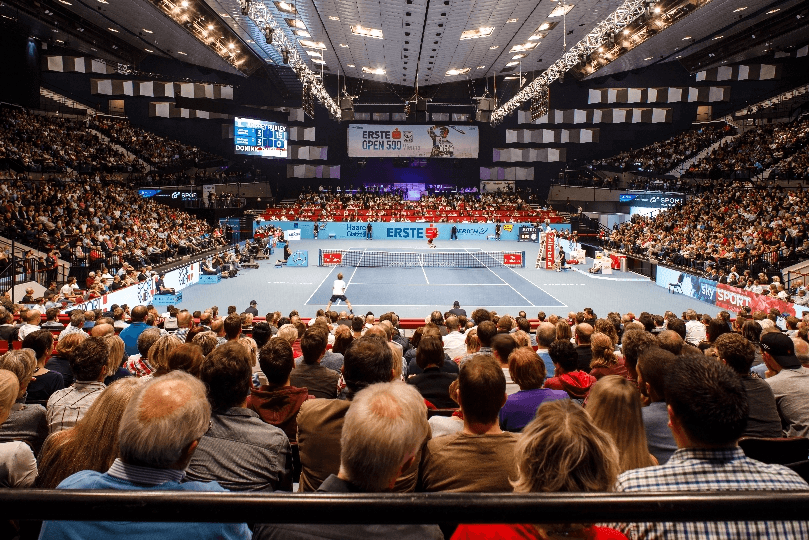
The Wiener Stadthalle Hall D is Austria's largest multi-purpose arena and one of Europe's most significant event venues. With a capacity of up to 16,000 spectators, it provides the perfect stage for international concerts, sports events, and large-scale productions. Since its opening in 1958, countless global stars have performed unforgettable concerts here.
For tennis, the configuration reduces to approximately 8,500 to 10,000 seats around Centre Court, creating an indoor atmosphere that benefits from the arena's existing acoustics and steep bowl geometry. The crowd noise in a sold-out Vienna evening session - which the later rounds consistently produce - is concentrated and intense in a way that outdoor venues of similar capacity never replicate.
The seating is sold in ranked categories from the premium court-level seats closest to the baseline and sideline through to the upper tiers. Category 1 seats are the closest to the court, ideal for reading serve direction, watching footwork, and experiencing the pace of indoor hard court tennis at full intensity. The upper tiers provide the full-court tactical perspective — both baselines visible simultaneously, the angles of groundstrokes readable across the full court width - which on a fast indoor surface where points are short and positioning matters enormously is genuinely informative.
Sun and lighting:
There is no sun consideration in an indoor arena. Every session at the Wiener Stadthalle runs under consistent artificial lighting. The arena temperature can vary - the arena can vary in temperature throughout the day, so dress in layers. This is specifically worth knowing for the transition between the outdoor temperature of late October Vienna (typically 5 to 12 degrees Celsius) and the interior of a heated arena. A light layer you can remove is the right approach rather than a heavy coat.
Camera policy:
Photography for personal use is permitted. Professional cameras with detachable lenses, tripods, monopods, and recording equipment are not permitted. Flash photography is prohibited.
Prohibited items:
Prohibited items include pyrotechnic or explosive materials, megaphones and noisemaking devices, laser pointers, tools, scissors, flags, helmets, umbrellas, and firearms and bladed weapons. Outside food and beverages are also not permitted. One factory-sealed water bottle is the typical exception - confirm on the official site before attending.
Food and Drink - The Tournament and the City
Inside the Stadthalle:
The food at the Wiener Stadthalle during the Erste Bank Open is managed to a standard that reflects the VIP Club's DO&CO catering relationship. DO&CO is one of the most respected premium event catering operations in Europe - their involvement extends to Formula 1 paddock clubs and Champions League finals hospitality - and even the general concourse food at the tournament benefits from the standards set at the premium level. Expect Austrian standards - sausages, schnitzels, warm drinks - delivered reliably and at prices that reflect Vienna's generally reasonable food costs rather than the inflated rates of British sporting venues.
The VIP Club is where the DO&CO catering operates at full standard. The exclusive catering throughout the day is the premium food experience at the tournament — worth knowing about if your interest is as much in the quality of what you eat as in the tennis.
At the Marx Halle:
The Marx Halle is in Vienna's 3rd district, adjacent to the Karmelitermarkt neighbourhood — one of the city's most genuinely local market areas. The Karmelitermarkt itself, open Tuesday through Saturday, is a smaller, less touristy alternative to the Naschmarkt, beloved by the chefs and locals who find the famous market increasingly crowded. Worth a morning visit if you are attending Marx Halle for an afternoon session.
Vienna's food culture — what to prioritise
There are three traditional Austrian dishes you must try: Wiener Schnitzel, Tafelspitz, and Austrian Beef Goulash. Plachuttas Gasthaus zur Oper serves the original Wiener Schnitzel and is fifteen minutes by metro from the Stadthalle. For Tafelspitz - Vienna's traditional boiled beef dish, ordered by choosing your preferred cut - Plachutta Wollzeile is the canonical address.
The Naschmarkt is a vibrant collection of over 120 market stalls located in Vienna, open Monday to Saturday. At 1.5km from the city centre and accessible by U4 to Kettenbrückengasse, it is Vienna's most famous food destination and worth a morning visit during the tournament week. Visit the stands, bars and restaurants on weekdays - they are less crowded and you may mingle with sous-chefs of many of Vienna's finest restaurants who shop there. For a sit-down meal within the market, Neni am Naschmarkt serves modern Israeli-Mediterranean fusion - the sabich, Jerusalem plate, or lamb kebab are the dishes to order.
One specifically October thing: if you visit in September or October, look out for signs for Sturm - a lightly sparkling, still-fermenting young wine available only for a few weeks each year, beloved by locals. You will find it at Naschmarkt wine bars and traditional Beisl restaurants across the city. It is sweet, low in alcohol, and one of those seasonal drinks that exists almost nowhere else. Try it at least once.
Vienna is the world's largest wine-producing city. Try Grüner Veltliner, Austria's signature dry white wine. If you can, visit a Heuriger - a wine tavern in the vine-growing hills of Grinzing or Nussdorf at the edge of the city - for an evening of local wine, cold cuts, and bread in an open courtyard. This experience is specifically Viennese and specifically October - the harvest season makes late October exactly the right time to be sitting in a Heuriger.
The coffeehouse
Vienna's coffeehouse culture is a UNESCO Intangible Cultural Heritage. Café Central, Café Landtmann, Café Hawelka, and Café Sacher are the most famous addresses. But any neighbourhood Kaffeehaus will serve the essential combination: a Melange (Vienna's version of a flat white), a glass of tap water brought unprompted, and a Sachertorte - the original chocolate cake created at the Hotel Sacher. The convention in a Viennese coffeehouse is to linger as long as you like. No one will hurry you. This is the city's contribution to the concept of spending an entire afternoon over a single coffee reading a newspaper. After a morning session at the Stadthalle, a coffeehouse hour before the evening session is the correct use of the gap.
What to Wear
Smart casual is the default for general admission, and smart dress is required in all VIP hospitality areas — the VIP Club, VIP Suites, and VIP Boxes. Sportswear, ripped jeans, and casual trainers are not appropriate in the hospitality areas. A jacket for the evening sessions is the baseline for anyone in the premium areas, and genuinely good-looking casual for general admission.
Late October in Vienna is autumn in earnest. The arena can vary in temperature throughout the day - dress in layers. Outside the Stadthalle, temperatures typically range from 5 to 12 degrees Celsius during the day and drop toward 3 to 7 degrees in the evening. Rain is possible across any week in October - a compact umbrella in your bag is sensible, and a proper coat for the evenings is not optional.
The transit journey between your hotel and the venue is a 15 to 20 minute metro ride, mostly underground. Comfort matters more than appearance for that part of the day. Save the coat pocket space: the Stadthalle has a cloakroom.
Things to Do Beyond the Tennis
The programme around the tournament
The spark7 Next Gen Day features exciting activities and autograph sessions with tournament stars. On ÖTV Day, stars of the tournament hold autograph sessions in the Stadthalle's fanzone. On Round of 16 day, there are autograph sessions and meet and greets with tournament stars at the Wiener Städtische booth in the fan zone. Check the official programme for the specific day you are attending - the autograph and fan engagement events change daily and are worth building into your schedule if player access matters to you.
Red Bull BassLine
The Red Bull BassLine is a separate concert event run alongside the Erste Bank Open, featuring live music acts in an atmospheric Vienna setting. Programme details are announced closer to the event but it is worth checking when booking your Vienna days - it has become one of the tournament's signature off-court events and is a natural extension of a tennis day for anyone staying into the evening.
Schönbrunn Palace
Schönbrunn Palace is an imperial summer residence with magnificent gardens. The palace is about 20 minutes by metro from the Stadthalle, reachable by U4 to Schönbrunn. The gardens are free to walk and in late October, when the summer crowds have gone and the trees are turning, they are genuinely beautiful. The State Rooms can be visited on a ticketed tour - the Grand Tour covering 40 rooms is the comprehensive option and takes about an hour.
Belvedere Palace and Klimt
The Belvedere Palace is home to Gustav Klimt's "The Kiss" and other masterpieces. The Upper Belvedere holds the most significant collection of Austrian art of any museum, with Klimt's "The Kiss" as the centrepiece — arguably the most reproduced painting in Austrian history and, in person, significantly more arresting than its ubiquitous reproduction suggests. Tickets can be booked online to avoid queuing. The Belvedere gardens are freely accessible and worth crossing in the late afternoon light.
The Vienna State Opera
The Vienna State Opera is a world-renowned opera house offering daily performances. Standing tickets for the State Opera (Stehplätze) are sold on the day of performance for €3 to €6 — one of the great cultural bargains in Europe. The queue for standing tickets forms from 80 minutes before curtain. For anyone in Vienna for the full tournament week, an opera evening - even standing for three hours - is an experience the city offers uniquely well.
The Prater and the Riesenrad
The Prater is Vienna's vast public park, home to the Riesenrad - the historic giant Ferris wheel that has operated since 1897 and appeared in The Third Man, Carol Reed's 1949 Vienna-set noir. A single ride offers a 360-degree view of the city at 65 metres. The Prater itself is free to enter and walk, with chestnut trees lining its main avenue that in late October are at their most spectacular.
Day trips from Vienna
Vienna's rail connections make it one of the best tournament cities for extending your trip. Budapest is 2 hours 40 minutes by train - worth a two-day extension if your schedule allows, one of central Europe's most compelling cities at a fraction of the Vienna hotel prices. Bratislava, the Slovak capital, is just 1 hour by train and often overlooked in favour of its larger neighbours - Old Town, castle, Danube. Salzburg is 2 hours 30 minutes for the Mozart city and Alpine scenery. All of these are easy rail journeys from Wien Hauptbahnhof with no booking complexity.
Insider Tip
The quarterfinal and semifinal sessions on Friday and Saturday are the sessions to prioritise, but the best-value day at the Erste Bank Open is Wednesday - ÖTV Day - when licensed tennis players get discounted entry and the autograph sessions in the fan zone consistently produce the most spontaneous player access of the week. Wednesday typically features the last round of 16 matches on Centre Court, which means the full eight players still remaining in the draw are on site, and the informal atmosphere of ÖTV Day creates better access to players before and after their matches than any other day of the tournament. Pair a Wednesday ticket with a morning at Naschmarkt and dinner in the first district, and it is as good a sports and city day as Europe offers in late October.
One practical note: there is an ATM directly beside the Wiener Stadthalle box office in Hall F. Vienna is generally card-friendly, but the Naschmarkt produce stalls, the Heuriger, and the traditional sausage stands operate on cash. Take some out before or after the tennis if you are planning an evening in the market areas.
Hospitality Packages
The Erste Bank Open has four premium hospitality options that give access to the VIP Club - where exclusive catering by DO&CO, Vienna's premier gourmet event caterer, is included alongside top-category Centre Court seating.
The VIP Day Pass is the most accessible option; top-category seating, full VIP Club access, exclusive DO&CO catering, and parking for one car per two tickets, bookable for any individual day of the tournament.
The ATP House, operated by ATP Experiences, adds access to the Red Bull Energy Station — the three-storey player relaxation venue where you can mix with players and their entourages between matches — alongside a gourmet buffet, premium bar, and an on-court photo experience on Centre Court.
The VIP Suite accommodates up to twenty guests in a fully private, individually designed space with Centre Court seating, a dedicated hostess, live match broadcast in the suite, and early access for pre-match seminars or client meetings.
The VIP Box provides a private branded box for six guests per day across the full tournament week, with company branding, a reserved VIP Club table, DO&CO catering, and three parking spaces per day.
All hospitality pricing is on enquiry — contact experience.tennis for availability and to discuss which option works best for your group and preferred dates.
Fan Reviews
Been to the Erste Bank Open? Tell us where you sat, what you ate, which coffeehouse you found before the session, and what surprised you most about Vienna in late October. Your review helps the next fan plan their trip, and the best tips make it into this guide.
[Submit your Erste Bank Open review →]
Ready to book?
Pair this guide with a hospitality package.
Fan Reviews
Sign in to leave a fan review.
No reviews yet. Be the first fan!